Three DGX Sparks and a Windows box, run from a laptop, for an agent-run hardware lab.
The three Sparks serve the embeddings, the critics and the search over my own documents. The Beelink hosts the FPGA tools. Three public repositories hold the tools.
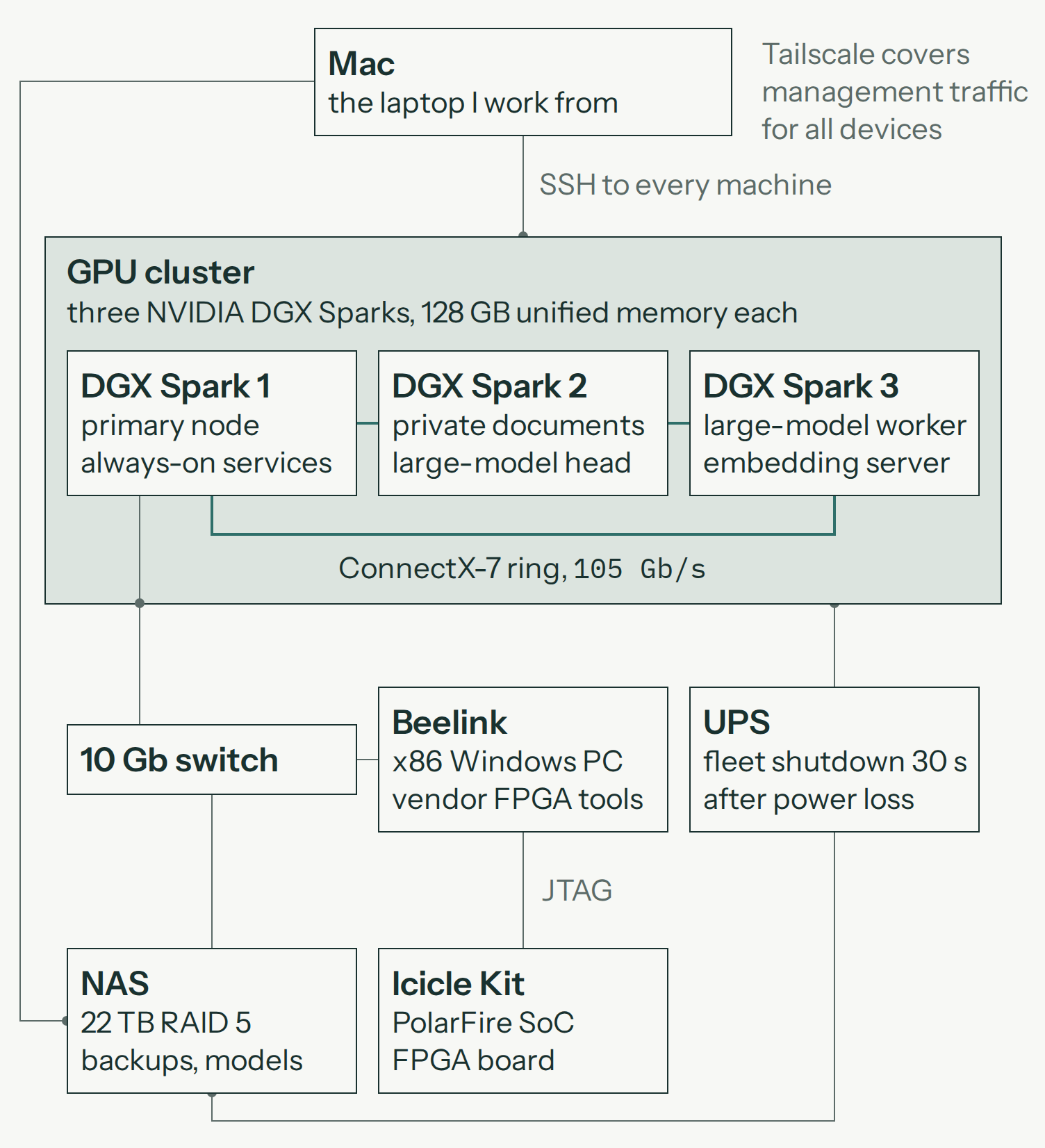
What runs where
- The primary Spark hosts embedding, reranker, Ollama, indexes, and the knowledge graph.
- The second Spark holds the sensitive company documents.
- The FPGA vendor's tools run only on x86 chips, and the Sparks are Arm machines. So the Beelink, an x86 mini PC, hosts Libero SoC, SmartHLS and the VectorBlox SDK in WSL. It is headless, and its backup runs on a daytime timer.
- The ring moves bulk data.
- The four-bay NAS also holds project data and has run 24/7 since July 2026.
- Untuned links measured 87.2 Gb/s. The ring uses MTU 9000. The 2026-10-28 NCCL bus bandwidth measured 22.4 to 23.3 GB/s.
- Idle timers stop vision and the page index after 30 minutes, and the large model after 60. A memory guard stops the largest unprotected GPU process.
Which model does which job
| Model | Where | When | |
|---|---|---|---|
| Embeddings | Qwen3-Embedding-4B | Primary machine | Always on |
| Reranking | Qwen3-Reranker-4B | Primary machine | Since 2026-10-21 |
| Query expansion | Small Ollama model | Primary machine | When a collection is large |
| Vision | Qwen3-VL-8B | Primary machine | On demand |
| Page-image search | 8B multi-vector | Primary machine | On demand |
| Long-context model | DeepSeek-V4-Flash | Second and third | On demand |
| Critics and audits | 32B and 9B | Local machines only | When an audit runs |
| Orchestration and code | Claude Code and Codex, cloud | From the primary machine | Every session |
| Search | Hybrid vector and keyword | Primary machine | Always on |
Scroll sideways for more columns.
Embeddings, reranking, critics and search run on my own hardware, while orchestration and code work go to cloud models.
Why local
Critics run only on local models. Sensitive company documents for a proposal stay on the second Spark. Indexing and search over my own documents run on my own hardware.
Local models carry the repeated heavy work (embedding, reranking, critics), so the cloud models go to orchestration and code. I ran the fleet, chose the models and flags, and reviewed every change.
How I reach it
I start the Beelink when I need the FPGA tools. I reach every machine from the laptop over SSH, and Tailscale carries the management traffic.
The second Spark has no coding agent installed, so I reach it directly from the primary machine. The memory guard stops processes under memory pressure.
Firmware updates happen one node at a time from the vendor tool. The primary machine receives updates last, most recently 2026-10-28.
Timeline
- First Spark installed.
- A Beelink was considered as the host for the FPGA board.
- The first local model serving ran on the Spark.
- A second Spark and the cable to join them were decided.
- The search for a UPS for the two machines began.
- The embedding service was set up on the primary machine.
- The third Spark arrived.
- The second machine was set up to hold sensitive company documents.
- The link between two Sparks was tuned to 105 Gb/s.
- The first Spark was retired after a hardware fault.
- The NAS moved to 24/7 operation.
- The three-node ring was built with the replacement Spark, and the large model was brought up.
- The vision model went live.
- A 20-minute full-load burn ran on all three machines.
- The page-image index was built.
- Three repositories from this work became public.
- The reranker was upgraded and a second embedder added.
Links
Checked November 20, 2026